
TL;DR:
- A music project encompasses a wide range of collaborative and solo musical efforts with shared intent.
- Flexibility and evolution are key, allowing projects to develop naturally beyond rigid plans.
- Community involvement through jams and networking fosters growth, confidence, and lasting musical relationships.
Most musicians assume a music project means a band rehearsing in a garage or an artist recording an album. That assumption leaves out a huge range of creative possibilities. A music project can be a one-off jam session, a cross-country online collaboration, a duo that meets monthly, or a loosely organized collective that plays local open mics. The label matters less than the intention behind it. Once you understand the full scope of what a music project can be, you stop waiting for the "right" conditions and start making music now. This guide covers definitions, types, growth patterns, community dynamics, and how to take your first real step.
Table of Contents
- What is a music project? Definitions and scope
- Types of music projects: From solo to collaborative
- How music projects grow: Evolution, agility, and creative dynamics
- Why community matters: Jam sessions, networking, and collaboration
- Perspective: What most guides miss about music projects
- Ready to start your own music project?
- Frequently asked questions
Key Takeaways
| Point | Details |
|---|---|
| Music projects are diverse | They can be solo, collaborative, temporary, ongoing, improvised, or structured depending on your goals. |
| Jam sessions build skills | Participating in jams boosts musicianship, confidence, and networking opportunities. |
| Collaboration drives creativity | Working with others leads to new ideas, learning, and long-term connections. |
| Flexibility is powerful | Open-minded, adaptable projects often yield the most rewarding music experiences. |
What is a music project? Definitions and scope
At its core, a music project is any organized effort to create, perform, or share music. That definition is intentionally wide. It covers a teenager recording bedroom beats, a trio of jazz musicians meeting weekly, a virtual ensemble collaborating across three time zones, and a spontaneous jam session that happens to produce a recorded track.
The word "organized" does a lot of heavy lifting here. It doesn't mean formal or rigid. It just means there's some shared intent, even if that intent is simply "let's play together and see what happens." That shared intent is what separates a music project from background music at a dinner party.
Here are some of the most common forms a music project can take:
- Solo projects: One musician handling all creative decisions, often multi-instrumentalist or production-focused
- Side projects: A secondary effort from musicians already in another band, usually with a distinct concept or sound
- Jam session collectives: Rotating groups that meet regularly to improvise, often without a fixed lineup
- Online collaborations: Musicians in different locations exchanging tracks, stems, or ideas digitally
- Concept projects: Time-limited efforts built around a specific theme, album, or event
One of the most useful distinctions is between temporary and ongoing projects. A jam session collective might run for a single season. A band might last decades. Both are valid. As solo projects evolve from individual efforts into collaborative bands, the boundaries between project types blur naturally.
"Temporary 'projects' may imply less commitment than 'bands,' and improvisatory music projects might use notation or 'let-go' modes differently."
This flexibility is a feature, not a bug. It means you can build a music community through sharing without locking yourself into a long-term commitment you're not ready for.
| Project type | Duration | Structure | Primary focus |
|---|---|---|---|
| Solo project | Ongoing or finite | Individual | Creation and production |
| Jam collective | Recurring or one-off | Loose | Improvisation and fun |
| Concept project | Finite | Moderate | Theme or album |
| Online collaboration | Variable | Flexible | Remote creation |
| Band | Long-term | Formal | Performance and recording |
Types of music projects: From solo to collaborative
Now that we've covered what a music project is broadly, let's look at the diverse types and what each can offer you.
A solo project puts you in full creative control. You write, arrange, record, and promote everything. The upside is total freedom. The downside is that every decision lands on your shoulders. Many solo artists eventually bring in collaborators, which is how solo projects evolve into bands or longer-term collectives over time.
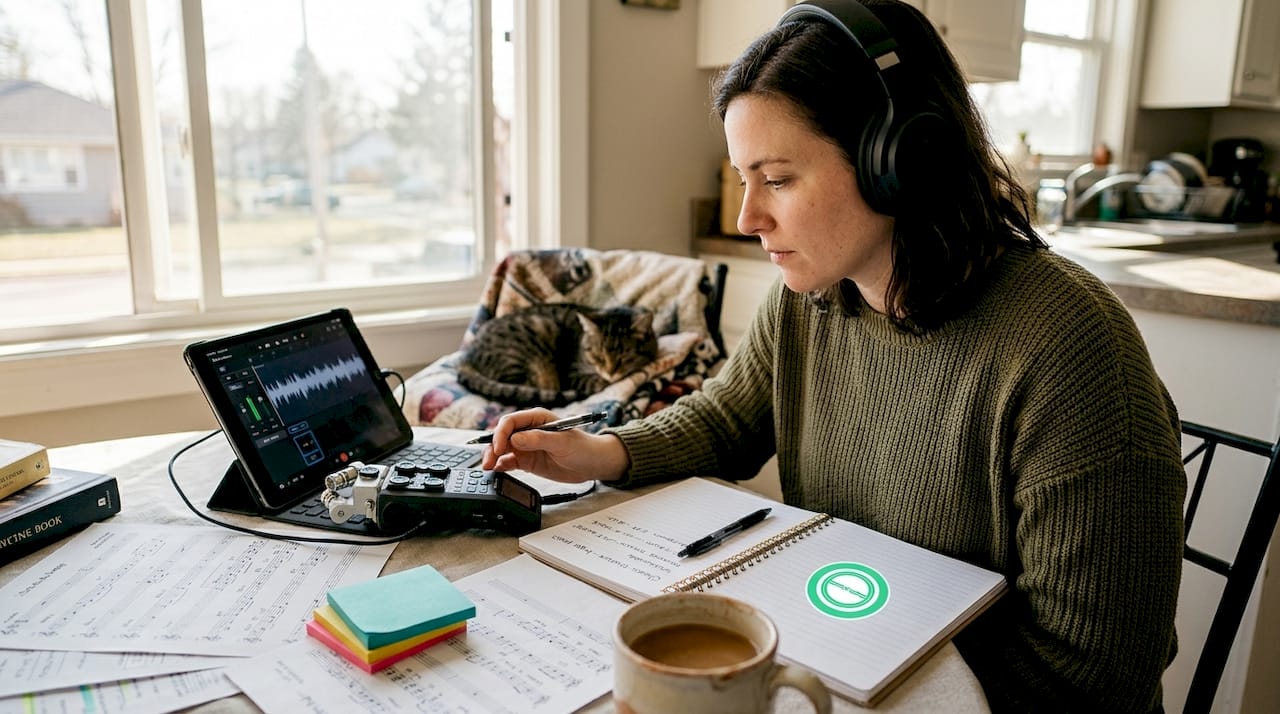
A duo or trio introduces creative friction in the best possible way. Two or three musicians must negotiate ideas, which often produces more interesting results than one person working alone. These smaller formats are also easier to schedule and sustain than full bands.
A band is the format most people picture first. Fixed members, regular rehearsals, shared goals. Bands carry more social weight and often more commitment, but they also offer the deepest sense of musical identity.
Online collectives are increasingly common. Musicians collaborate asynchronously, passing files back and forth, sometimes never meeting in person. These projects can pull in wildly different influences and skill sets.
Jam session groups are the most informal structure. There's often no fixed membership, no setlist, and no pressure. They function as incubators where ideas and relationships form naturally.
Common goals across all music project types include:
- Writing and recording original music
- Performing live or at local events
- Building a social media presence or audience
- Developing specific skills or exploring new genres
- Networking and finding future collaborators
Pro Tip: Use a jam session checklist before your first meeting to set expectations without killing the spontaneity. And if you're thinking about hosting, reviewing local event planning for jams can save you a lot of headaches.
| Format | Commitment level | Best for | Flexibility |
|---|---|---|---|
| Solo | High (self-driven) | Full creative control | High |
| Duo | Medium | Tight collaboration | High |
| Band | High | Long-term performance | Low to medium |
| Jam group | Low | Skill-building, fun | Very high |
| Online collective | Variable | Remote creativity | High |
How music projects grow: Evolution, agility, and creative dynamics
Understanding the project types sets the stage for how these initiatives actually grow and adapt. Let's examine their evolution.
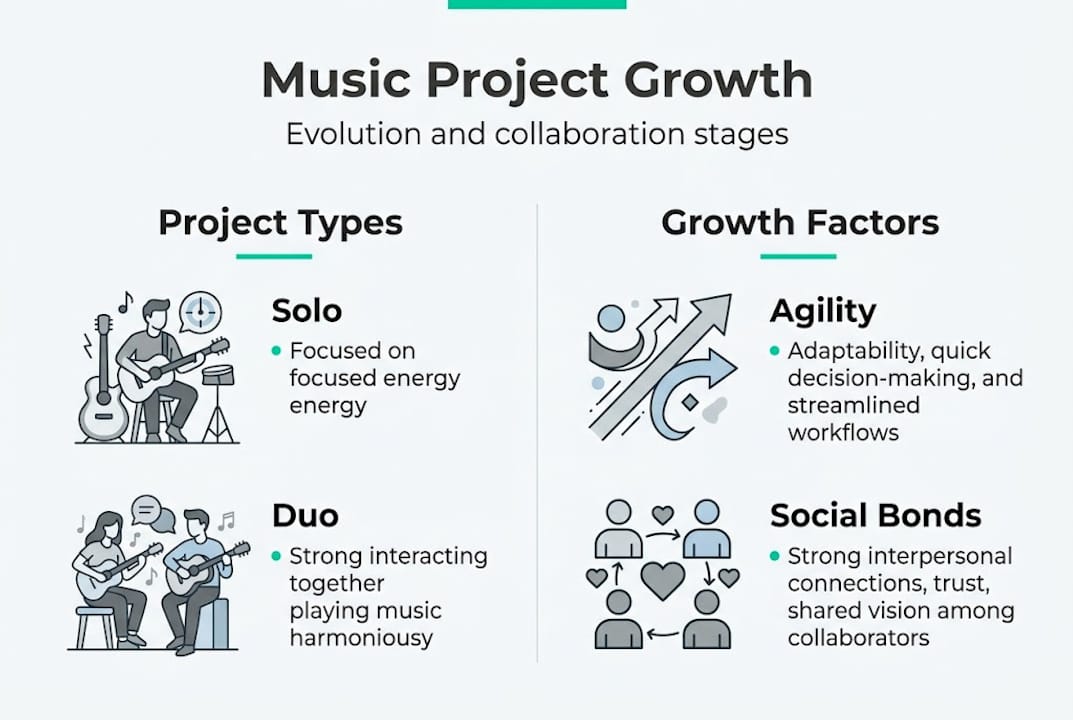
Most music projects don't follow a straight line. They start with an idea or a conversation, gather momentum, hit a wall, reinvent themselves, and sometimes become something completely different from what was originally planned. That's not failure. That's how creative work actually moves.
Here are the key stages most music projects move through:
- Inspiration: A spark, a conversation, or a shared listen that makes two or more people say "we should do something."
- Formation: Deciding on roles, goals, and format, even loosely.
- Iteration: Playing, recording, or performing and then adjusting based on what works.
- Public sharing: Releasing music, playing shows, or posting content to get feedback from an audience.
- Legacy or transition: Either the project finds its long-term identity or it wraps up and feeds into something new.
Agile methods with sprints and iterative feedback loops, borrowed from software development, work surprisingly well for music. Weekly reviews help you catch problems early and keep creative energy from stalling.
The science backs this up too. Movement synchrony predicts interaction bouts over 80% of the time in non-pulsed music, which means the physical and relational chemistry between musicians is a real, measurable force in how projects develop.
Pro Tip: Treat your music project like a sprint, not a marathon. Set a small, clear goal for each week or session, whether that's finishing a verse, recording a demo, or simply sharing music online. Small wins build momentum faster than grand plans.
The social dynamics matter just as much as the musical ones. Strong networking and collaboration in jams create the relational foundation that allows projects to survive disagreements, lineup changes, and creative dry spells.
Why community matters: Jam sessions, networking, and collaboration
The evolution of a music project isn't just about the music or people. Community is the glue that brings it to life.
Jam sessions are often underestimated as a serious form of music project. They feel casual, even throwaway. But they are some of the most powerful incubators for musical growth. In a jam, you practice real-time listening, respond to unexpected changes, and build confidence in a low-stakes environment. Those skills transfer directly into more formal projects.
Jam sessions foster skills, confidence, and connections, and the collaborations that grow out of them often build lasting relationships and real exposure within local music scenes.
Benefits of participating in jam-based music projects include:
- Rapid skill development through real-time improvisation
- Exposure to genres and styles outside your comfort zone
- Organic networking with musicians you'd never meet otherwise
- Confidence in performing without a safety net
- Potential discovery of long-term collaborators or bandmates
"Jam sessions foster skills, confidence, connections; collaborations build lasting relationships and exposure."
Community music projects also tend to outlast formal bands. When a band breaks up, the relationships often dissolve with it. But a jam collective or local music community keeps going because it's built on a network, not on a fixed lineup. Audience perception research shows that improvisatory, loosely structured projects often create stronger audience connection than tightly scripted performances.
If you want to plan a jam session that actually builds community, focus on creating a welcoming environment over a polished one. And don't underestimate the power of sharing musical experiences afterward, whether that's a quick post, a recording, or just telling people it happened. Visibility feeds the music community building process in ways that private rehearsals never can.
Perspective: What most guides miss about music projects
Most articles about music projects tell you to pick a format, set long-term goals, and commit. That advice sounds reasonable. In practice, it stops a lot of musicians before they even start.
The projects that actually survive, and the ones that produce the most memorable music, are rarely the ones with the most detailed plans. They're the ones that stayed flexible long enough to find their own shape. A duo that started as a "temporary thing" becomes a decade-long creative partnership. A one-time jam session turns into a monthly collective that feeds three different bands.
Conventional wisdom treats impermanence as a weakness. We'd argue it's often the whole point. When you organize music gatherings without rigid expectations, you create space for the unexpected. That's where the best music lives.
Pro Tip: Embrace short-term projects on purpose. Give yourself a six-week window to create something with a new collaborator. The deadline creates focus, and the low stakes create freedom. You'll be surprised how often "temporary" becomes something you want to continue.
Stop waiting for the perfect format. Start with what's available and let the project tell you what it wants to become.
Ready to start your own music project?
You've got the framework. Now it's time to act on it.
JamClub is built specifically for musicians who want to move from thinking about a project to actually doing one. Whether you're looking to explore JamClub's platform to find nearby sessions, create your first jam and invite musicians in your area, or simply connect with musicians who share your style and goals, JamClub gives you the tools to make it happen for free. RSVP management, real-time messaging, and a growing community of players at every skill level are all waiting. Your next music project might be one session away.
Frequently asked questions
What is the main difference between a music project and a band?
A music project can be temporary or collaborative with flexible members and goals, while a band implies more permanence and structured commitment. Projects are often more experimental and open-ended by design.
Can joining a jam session count as starting a music project?
Absolutely. Organizing or joining a jam session is a legitimate music project, especially when the goal is to build skills and connections with other musicians over time.
How do music projects typically evolve over time?
Most start small, as solo or duo efforts, and grow into collaborative ventures. Solo efforts evolve into bands as relationships deepen, and agile iterative feedback helps projects adapt their direction along the way.
What's the benefit of collaborating with other musicians rather than going solo?
Collaboration accelerates creativity and skill development. Jam sessions build confidence and connections that solo work rarely produces, and relational plasticity in duos increases creative output significantly compared to working alone.