
TL;DR:
- Attending local jam sessions and open mics builds essential in-person musical networks.
- Professional preparation like an EPK and consistent follow-up enhances networking success.
- Creating your own jam or open mic can strengthen community ties and career opportunities.
Breaking into the music scene can feel like showing up to a party where everyone already knows each other. You're talented, you're motivated, but finding the right people to play with, learn from, and grow alongside feels frustratingly out of reach. The good news is that the music world is far more open than it appears from the outside. Whether you're an amateur guitarist looking for your first band or a seasoned session player wanting to expand your circle, the right networking strategies can turn isolated practice sessions into a thriving creative community. This guide walks you through exactly how to find opportunities, prepare professionally, build lasting relationships, and even create your own scene.
Table of Contents
- Finding local jam sessions and networking events
- Preparing professionally for successful networking
- Building relationships: Consistency, depth, and value
- Creating your own jam or open mic
- Turning networking challenges into your biggest strengths
- Connect with musicians and boost your music journey
- Frequently asked questions
Key Takeaways
| Point | Details |
|---|---|
| Use jam sessions | Local jams and open mics offer easy, low-pressure ways to meet and connect with other musicians. |
| Prepare professionally | Having your pitch, EPK, and social links ready makes networking efforts more impactful. |
| Be consistent | Regularly attending events builds familiarity and deeper relationships within the music scene. |
| Lead with value | Supporting others and following up quickly helps nurture lasting connections. |
| Create your own events | Starting your own jam or open mic fosters community and expands your network when options are limited. |
Finding local jam sessions and networking events
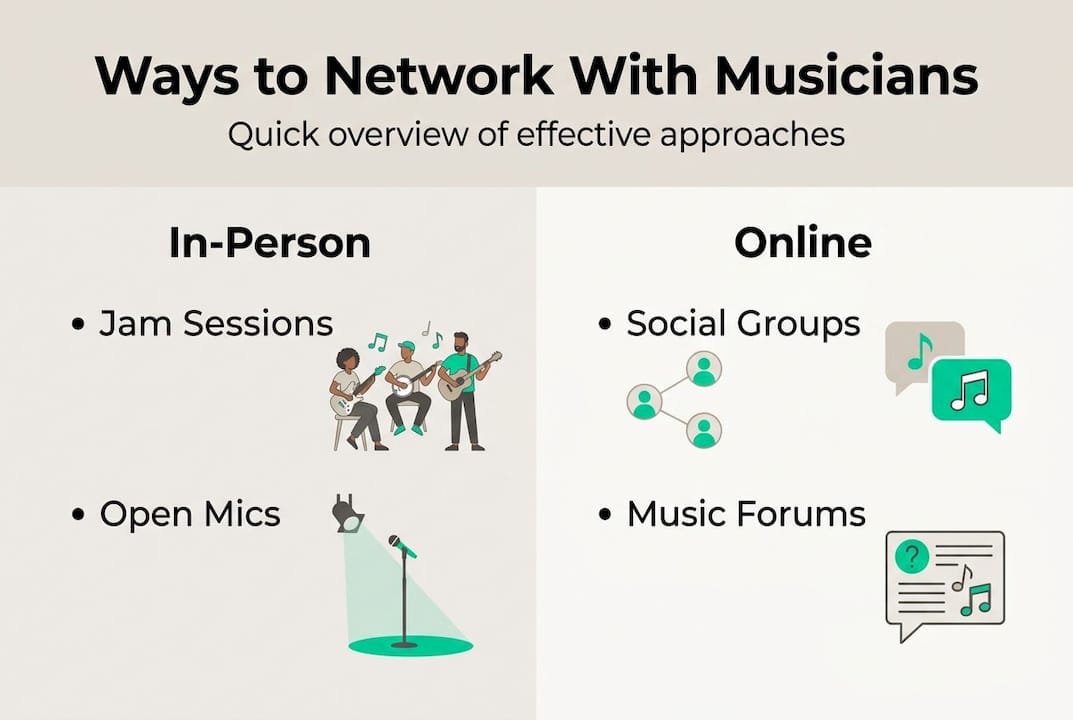
The most direct path to meeting other musicians is also the most underrated: showing up in person. Attending local jam sessions and open mics gives you a low-pressure environment where playing together naturally breaks the ice. You don't need a polished set or a business card. You just need to show up with your instrument and a willingness to listen.
But finding these events takes a little research. The good news is that both online and in-person discovery methods work well, and combining them gives you the widest net.
| Discovery method | Best for | Limitations |
|---|---|---|
| Online platforms (Meetup, Reddit) | Finding events quickly, filtering by location | Listings can be outdated |
| Local music stores | Reliable, community-vetted events | Limited reach outside the area |
| Social media groups | Real-time updates, direct contact | Can be noisy and hard to filter |
| JamClub platform | Musician-specific discovery and RSVP | Focused on jam sessions specifically |
Using online directories and platforms like Meetup.com, Reddit, TheSession.org, and local music association websites is one of the fastest ways to find current events near you. Pair that with a music event discovery guide to make sure you're not missing anything in your area.
Here are some practical tips for finding events:
- Search Reddit communities like r/musicians or your city-specific music subreddits
- Check local music store bulletin boards, both physical and digital
- Use JamClub to find jam sessions filtered by location and instrument
- Follow local venues on social media for open mic announcements
- Ask at your local music school or community center
Consistency is what separates casual attendees from people who actually build a network. When you show up to the same event week after week, you stop being a stranger. People start saving you a spot, introducing you to others, and thinking of you when a band needs a fill-in. Use this jam session checklist to make sure you're getting the most out of every event you attend. Also, reviewing a solid networking checklist before your first few events can help you walk in with a clear plan.
Preparing professionally for successful networking
Showing up is half the battle. The other half is being ready when someone asks, "So, what do you do?" That moment passes fast, and musicians who fumble it often miss real opportunities.
Before your next event, work through these preparation steps:
- Build or update your EPK (Electronic Press Kit): This is your professional introduction. It should include a bio, photos, audio or video samples, and contact information.
- Craft a 30-second pitch: Know how to describe your sound and goals in plain language. Avoid jargon.
- Set up a link-in-bio page: Tools like Linktree let you share your music, socials, and booking info in one link.
- Engage on social media before the event: Comment on other musicians' posts, share your work, and be visible.
- Bring a way to exchange contact info: A simple digital card or a memorable social handle works fine.
Here's a quick look at the essential tools every networking-ready musician should have:
| Tool | Purpose | Priority |
|---|---|---|
| EPK | Professional introduction | High |
| 30-second pitch | Verbal first impression | High |
| Link-in-bio page | One-stop digital presence | Medium |
| Social media profiles | Ongoing visibility | Medium |
| Demo recordings | Proof of your sound | High |
The data behind professional preparation is hard to ignore. Artists with 5+ industry relationships experience career growth three times faster, and collaborations can boost audience engagement by 40%. That's not a small edge. That's the difference between spinning your wheels and actually gaining momentum.
For deeper inspiration on how other musicians have used events to grow, check out these musician networking events and explore music sharing online tips to extend your reach between in-person meetings. Berklee's resource on music promotion strategies is also worth bookmarking.
Pro Tip: Follow up with every new contact within 48 hours. A short message referencing something specific from your conversation shows you were genuinely paying attention, and it sticks.
Building relationships: Consistency, depth, and value
Meeting someone once at a jam session doesn't make them part of your network. What you do after that first meeting is what actually builds the relationship.
Here are the most effective ways to deepen your connections with other musicians:
- Attend their shows and tell them what you genuinely liked about their performance
- Offer a skill you have, whether that's recording, mixing, or just knowing a great rehearsal space
- Make introductions between musicians who would benefit from knowing each other
- Engage consistently with their social media content, not just when you need something
- Follow up within 48 hours after leading with value by supporting others in tangible ways
"Prioritize consistency and depth over breadth: show up regularly to the same events to become a familiar face, focusing on 20 deep relationships rather than hundreds of shallow ones."
This is counterintuitive for a lot of musicians who think networking means collecting as many contacts as possible. It doesn't. A tight circle of 15 to 20 people who genuinely know and trust your work will open more doors than 500 LinkedIn connections who barely remember your name.
Consistency at live events is one of the most underused tools in a musician's networking arsenal. When you become a regular at the same open mic or jam night, you become part of the fabric of that community. People start tagging you in posts, recommending you for gigs, and collaborating with you on projects. Read more about how to leverage live music events tips to make every appearance count.
Building relationships also means being patient. Most meaningful musical partnerships take months to develop. Use the relationship-building checklist to track your follow-ups and make sure no connection goes cold.
Pro Tip: Pick 5 to 10 musicians in your local scene and make it a point to genuinely support their work for 90 days before asking for anything in return. The reciprocity that follows is almost always organic and lasting.
Creating your own jam or open mic
Sometimes the best networking move is building the table yourself. If your local scene is thin or the existing events don't fit your style, starting your own jam or open mic puts you at the center of the community you want to build.
Here's how to get started:
- Choose a venue: Coffee shops, bars, community centers, and rehearsal studios are all viable. Start small and low-cost.
- Set a recurring schedule: Weekly or bi-weekly events build habit and community faster than one-off shows.
- Define the format: Will it be a structured open mic, a free-form jam, or genre-specific? Clear expectations attract the right crowd.
- Promote it online and offline: Use JamClub to list your event, post in local Facebook groups, and put up flyers at music stores.
- Welcome all skill levels explicitly: State it in your promotional materials. Beginners need to know they're safe to show up.
The community values you build into your event from day one will define who attends and how long they keep coming back. Focus on:
- Patience with beginners and those still finding their voice
- Encouragement over critique in a public setting
- Inclusivity across genres, instruments, and backgrounds
- A no-pressure atmosphere where experimentation is celebrated
When you start your own jam with community values at the core, you attract both amateurs and pros who are tired of scenes that feel cliquish or competitive. Your event becomes the one people actually look forward to. Explore how to establish local connections and get into the details of jam session planning to make your launch as smooth as possible.
Turning networking challenges into your biggest strengths
Here's a perspective most networking guides won't give you: the hardest parts of building your music network are also the most powerful.
When jam sessions are scarce in your area, the musicians who do show up are more committed. There's less noise and more signal. The connections you make in a thin scene tend to be deeper and more loyal than those made in a saturated one where everyone is constantly chasing the next opportunity.
Patience and consistency will set you apart more than technical ability ever will. Most musicians quit showing up after a few events. The ones who stay become indispensable. They get called first for gigs, collaborations, and referrals.
Small, tight networks also grow faster than large, shallow ones because trust travels quickly in close circles. One strong advocate in your corner is worth a hundred passive followers. Explore more musical networking insights to see how this plays out in real musician communities. The obstacles you're facing right now are not roadblocks. They're filters that remove the uncommitted, leaving space for you to become someone people genuinely want to play with.
Connect with musicians and boost your music journey
You now have a clear roadmap for finding events, showing up prepared, building real relationships, and even launching your own scene. The next step is having the right tools to make it all easier.
JamClub is built specifically for musicians like you. Whether you want to find and create jam sessions near you, connect with players across skill levels, or use real-time messaging to coordinate your next rehearsal, JamClub brings it all together in one free music community app. You can also create your own jam directly on the platform, manage RSVPs, and grow your local scene without the logistical headaches. Your next great musical partnership is closer than you think.
Frequently asked questions
What is the best way to find jam sessions nearby?
The most effective approach is using musician-focused platforms and online directories. JamClub, Meetup, and Reddit all list current local jam and open mic events, and combining a few sources gives you the most up-to-date options.
How can I make a strong impression when networking with musicians?
Arrive prepared with an updated EPK, a clear 30-second pitch, and active social profiles. Professional preparation also means following up within 48 hours of meeting someone new.
How many relationships should I focus on for the best networking results?
Quality beats quantity every time. Focusing on 20 deep relationships with genuine trust and mutual support will deliver far greater career results than maintaining hundreds of surface-level contacts.
What should I do if there aren't any open mics or jam sessions in my area?
Start your own. Emphasizing community values like patience and encouragement in your event's culture will attract musicians of all experience levels and build something lasting.
Does networking with musicians really help my career?
Absolutely. Musicians with 5+ relationships grow their careers three times faster, and collaborations increase audience engagement by 40%, making networking one of the highest-return investments you can make in your music career.